Not Insurance Advice
This page explains general rules. Your policy, its endorsements and your insurer decide what's covered. CDI's consumer hotline is 1-800-927-4357.
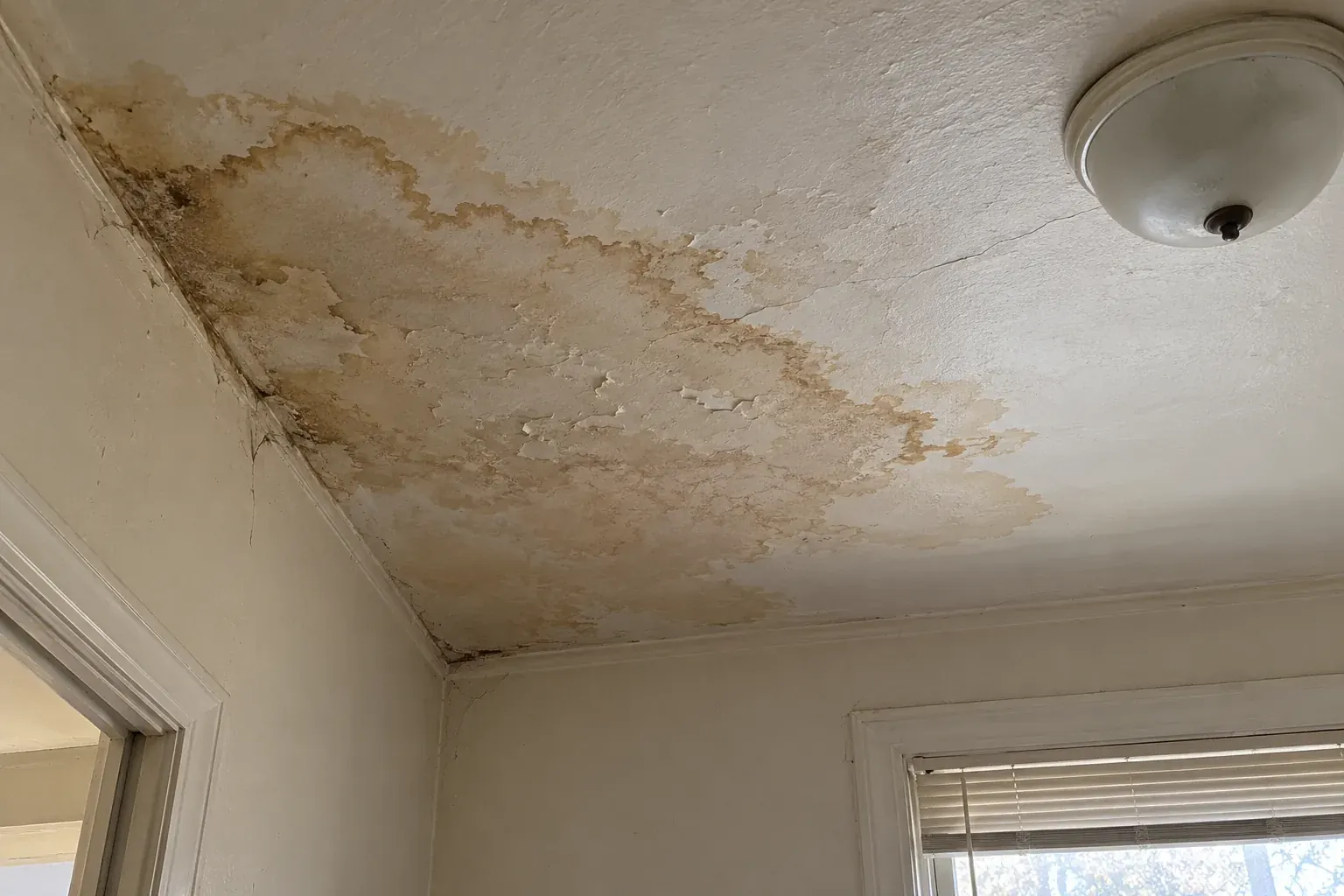
Stop the water getting further, document it for the claim, and get the right trade for each part of the damage.
Roof leaking into the house?
Water from a roof leak rarely shows up where it gets in. It runs along rafters and the top of the ceiling before it stains, drips or brings down drywall. What you do first decides how much of the house it reaches, and California's Department of Insurance is clear that it also affects the claim: policies may not cover further damage if you didn't take reasonable steps to stop it.
This page explains general rules. Your policy, its endorsements and your insurer decide what's covered. CDI's consumer hotline is 1-800-927-4357.
Sources: California Department of Insurance, Residential Property Claims Guide; EPA, A Brief Guide to Mold, Moisture and Your Home. Tarp cost from our emergency roof repair page.
Two different trades fix two different problems. The roofer stops the water at the source: the cracked tile, the failed flashing, the worn pipe boot. A water damage restoration company dries the building: extraction, dehumidifiers, removing wet insulation and drywall. The industry standard for that work, IICRC S500, assumes the owner gets the source fixed by someone else, which is exactly the split.
| What you see | Who to call |
|---|---|
| A drip or a small stain, ceiling still firm | A roofer to find and fix the leak. You can usually dry a small area yourself. |
| Wet insulation, soaked drywall or carpet, a sagging ceiling | A restoration company to dry the building, and a roofer for the source. |
| Visible mold over about 10 square feet, or water in the HVAC system | A professional, per EPA guidance, plus your insurer. |
One correction to a common claim: rain coming through a roof is not automatically "Category 3" black water. In March 2026 the IICRC S500 consensus body said weather-related water entering from above isn't automatically Category 3; the restorer decides after inspecting. A contractor who skips that step to justify a bigger job is worth questioning.
Sources: IICRC S500; IICRC weather-related water position statement, 2026; EPA, mold cleanup in your home.
It turns on cause. CDI says homeowners policies generally pay for damage from rain coming through a hole in the roof when the hole was caused by a covered peril, such as wind. Gradual seepage, wear and tear and deferred maintenance are generally excluded, and flood isn't covered by a homeowners policy at all. A leak from an old, worn roof is the hardest case. For how roof age changes a claim, see will insurance cover your roof.
Once you file, California's Fair Claims Settlement Practices Regulations set the insurer's clock:
| Step | Deadline |
|---|---|
| Acknowledge your claim and start the investigation | 15 calendar days |
| Accept or deny, after receiving proof of claim | 40 calendar days |
| Pay, after accepting the claim | 30 calendar days |
The 40 days run from proof of claim, not from the day of the leak, and an insurer that needs more time must tell you in writing every 30 days. A written denial has to give its reasons.
Sources: CDI Residential Property Claims Guide; 10 CCR §2695.5 and §2695.7; Insurance Information Institute.
A public adjuster works for you on the claim, not on the repair, and is paid a percentage of the settlement. In California they must hold a public adjuster license from CDI, which you can check on CDI's license lookup. The contract has to be on a state-approved form that states the fee percentage, and you get 3 business days to cancel. For an ordinary roof leak, many homeowners handle the claim themselves; an adjuster earns the fee on larger, disputed losses.
Sources: Insurance Code §15027; CDI license lookup.
Once the house is protected, the roof needs a real repair, and the stain on the ceiling is a clue, not the answer. Common sources in Los Angeles are cracked or slipped tiles over worn underlayment, failed flashing at chimneys and walls, worn pipe boots and ponding on flat roofs. Common roof problems walks through each, and roof repair covers how a leak gets traced. If it's raining now, start with emergency roof repair. Before you hire anyone, run their license through the CSLB check.
Keep people away from any sagging ceiling, catch the water, move belongings, and photograph the damage. Then get the opening covered with a tarp or plywood and keep the receipt; California's Department of Insurance says policies may not cover further damage if reasonable steps weren't taken.
Generally yes when the leak comes from a covered event, such as wind opening the roof. Gradual seepage, wear and tear and lack of maintenance are generally excluded. Your policy decides, so read it and report the claim promptly.
Often both. The roofer fixes the source of the leak; a restoration company dries the building when insulation, drywall or flooring is soaked. A small stain on a firm ceiling usually needs only the roofer.
EPA's guidance is to dry water-damaged areas and items within 24 to 48 hours to prevent mold growth. Mold covering more than about 10 square feet calls for a professional.
Not automatically. The IICRC's water damage standard body said in 2026 that weather-related water entering from above isn't automatically Category 3; the restorer decides after inspecting.
Under California's Fair Claims Settlement Practices Regulations, the insurer must acknowledge the claim within 15 days and accept or deny it within 40 days of receiving proof of claim, then pay within 30 days of accepting.
Tell us where the water is showing up and what kind of roof you have. A roofer will reach out to trace the source and write up the repair.